
To play roulette, you put chips on a single number, a group of numbers, or a color such as red or black, and if the ball lands in a pocket your bet covers, you win. A single number pays 35 to 1 and red or black pays 1 to 1, the same on every standard wheel.
What changes is the zero: a European wheel has one green zero and a 2.70% house edge on every bet, while an American wheel adds a double zero and raises the edge to 5.26%.
Learning how to play roulette online is easy, because the bets and payouts match what you’d find at a retail casino. At a licensed US site, you can pick an RNG table with a computer wheel or a live dealer table with a real wheel on video. Bets run from $0.10 up to $20,000 at the top live tables.
The big thing to know is that your bets don’t change the house edge, other than the first five bet on an American table. So the only choices that matter are which wheel you play and how much you bet.
What I Liked and Disliked About Online Roulette
I have mixed feelings about roulette. I like how simple it is, and on a single-zero wheel a beginner can’t make a costly mistake. The downside is that nothing you do will lower the edge. That’s why I spend most of my time at blackjack and poker tables.
The first thing I always check is the wheel. One green zero means a 2.70% edge. If I see a 0 and a 00, that’s 5.26%, and I close the game right away. Then I read the table rules for the payouts and for La Partage.
My usual bet is $10 on red. It wins $10 on 18 of the 37 pockets and loses on the other 19, zero included. Sometimes I’ll add $1 on a single number for a shot at a $35 win.
What I Liked
- Single-zero tables are easy to find. FanDuel’s NJ lobby lists European Roulette (Evolution, RNG) from $0.10 to $5,000 a spin.
- Every bet on a single-zero wheel is 2.70%. A beginner can’t pick a worse bet on that wheel, whether it covers 1 number or 18.
- Posted RTPs match the math. BetMGM lists its American Roulette at 94.74% RTP, which is 100% minus the 5.26% edge.
What I Disliked
- American tables sit right next to European ones. They pay the same but carry nearly twice the edge, 5.26% against 2.70%. The first five bet on a double-zero layout is 7.89%, if the table offers it.
- Lightning straight-ups pay 29 to 1, not 35 to 1. If your number isn’t struck, that bet returns only 81.08%, and players say the multipliers don’t hit often.
- Doubling systems fail at the table limit. Martingale players do fine until a run of 8 or more losses, which shows up in 69% of 500-spin sessions on a single-zero wheel.
- Losing streaks feel rigged. I’ve seen plenty of players call a table cold after a bad run, and none of those complaints came with proof.
European roulette is a good pick if you want a game with no decisions to get wrong. Set a budget before the first spin. The 2.70% edge sits in the middle of the casino games, and no strategy lowers it. I’d skip it if you plan to run a doubling system or expect 35 to 1 on a Lightning straight-up.
American roulette is worse. At 5.26% on almost every bet, it gets AVOID IT MATEY from me.
How to Play Roulette: How a Round Plays Out
Roulette for beginners is simple: you place your bets, the wheel spins, and one pocket decides every bet on the table. The steps are the same at an RNG table and a live dealer table. Online, nobody else’s bets affect yours.
Check the Wheel
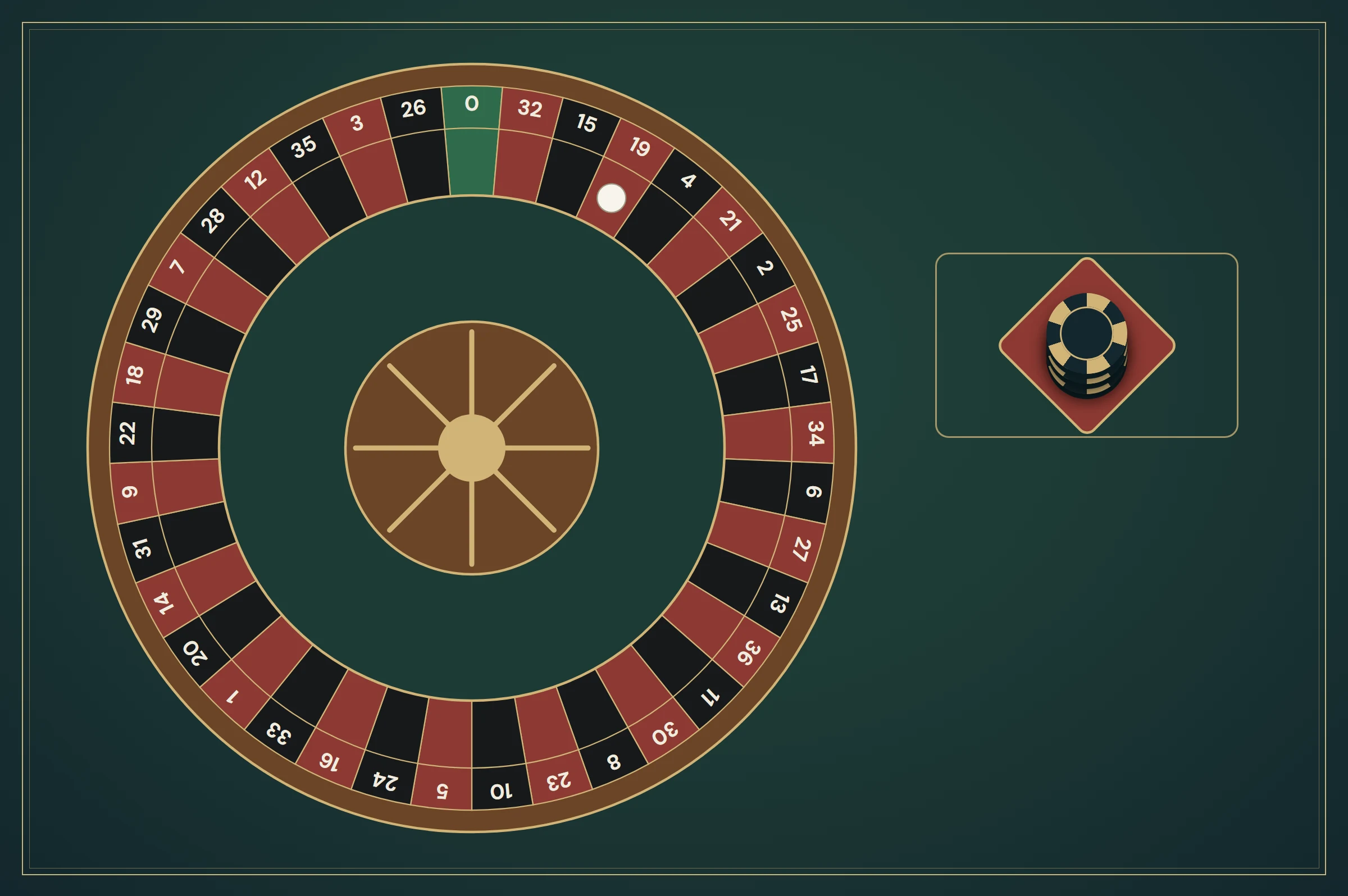
Before anything else, look at the zeros. One green 0 means a European wheel with 37 pockets. A 0 and a 00 means an American wheel with 38.
Place Your Chips
Pick a chip value and put chips on a number, on a line between numbers, or in an outside box. Check the table’s minimum and maximum first, since some tables start at $0.10.
Betting Closes and the Wheel Spins
At an RNG table, software picks the result. At a live table, a dealer spins a real wheel on video.
The Ball Lands
Every bet that covers that pocket wins at the table’s payout. Every other bet loses.
Bet Again
The table clears, and you can bet again on the next spin.
I don’t worry about RNG roulette at a licensed site. In Pennsylvania, the state’s gaming lab tests every online game before the Board approves it, and New Jersey requires RNG results that pass recognized tests.
Roulette Rules and Bets
Every roulette bet falls into one of two groups. Inside bets go on the numbers themselves, and outside bets go in the boxes around them. The trade-off is simple: inside bets pay more, but they win less often.
Roulette Numbers, Colors, and Table Layout
The roulette numbers run from 1 to 36, plus a green 0, and an American wheel adds a green 00. Eighteen numbers are red and eighteen are black. On the roulette layout (the betting table), the numbers sit in three rows of twelve. The outside boxes group them into dozens, columns, and even-money bets.
- 18
Red
1, 3, 5, 7, 9, 12, 14, 16, 18, 19, 21, 23, 25, 27, 30, 32, 34, and 36.
- 18
Black
2, 4, 6, 8, 10, 11, 13, 15, 17, 20, 22, 24, 26, 28, 29, 31, 33, and 35.
- 0
Green
The 0, plus the 00 on an American wheel.
- 3
Dozens
1 to 12, 13 to 24, and 25 to 36.
- 3
Columns
1, 4, 7 to 34; 2, 5, 8 to 35; and 3, 6, 9 to 36.
Don’t expect the roulette wheel numbers to run in order from 1 to 36. Red and black alternate around the wheel, and on a single-zero wheel the 0 sits between 32 and 26.
Roulette Inside Bets
Inside bets cover one to six numbers. The fewer numbers you cover, the bigger the payout when you hit.
- 1
Straight Up
One number. Pays 35 to 1.
- 2
Split
Two numbers next to each other, on the line between them. Pays 17 to 1.
- 3
Street
A row of three numbers, at the end of the row. Pays 11 to 1.
- 4
Corner
Four numbers that meet at one point. Pays 8 to 1.
- 6
Six Line
Two rows of three, on the line between them. Pays 5 to 1.
- 5
First Five
0, 00, 1, 2, and 3 on an American table. Pays 6 to 1, and it’s the worst bet on the layout at 7.89%, if the table offers it.
Roulette Outside Bets
Outside bets cover 12 or 18 numbers, so they win more often. A dozen or a column pays 2 to 1. Red, black, odd, even, 1 to 18, and 19 to 36 all pay 1 to 1 (even money).
Keep in mind that every outside bet loses when the ball lands on a zero, on both standard European and American tables. That zero is where the casino gets its edge on those bets.
Roulette Payouts Chart
Each lettered chip in the image matches the Chip column in the chart.
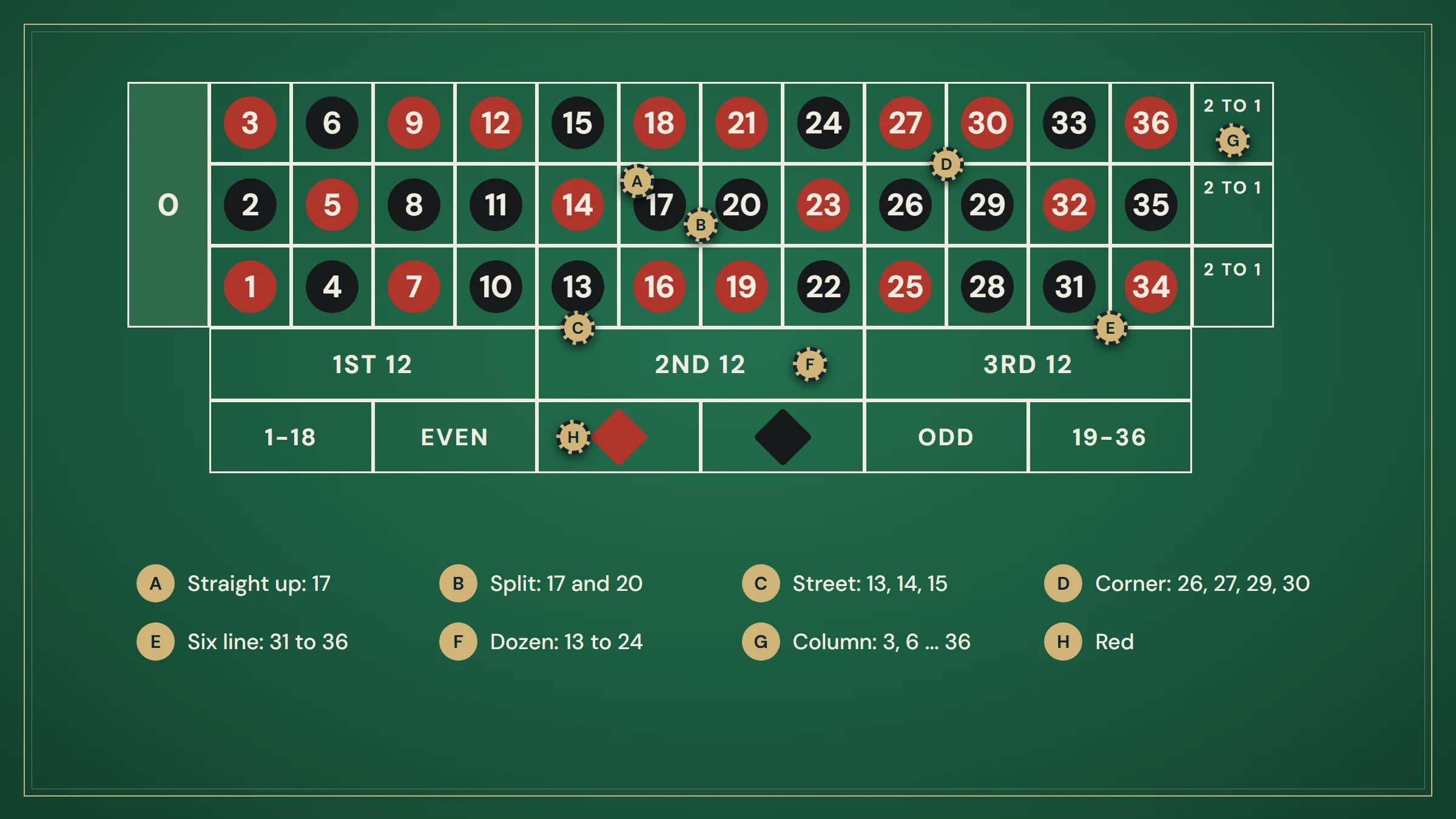
| Bet | Chip in Image | Numbers Covered | Pays | $10 Bet Wins |
|---|---|---|---|---|
| Straight up | A (17) | 1 | 35 to 1 | $350 |
| Split | B (17 and 20) | 2 | 17 to 1 | $170 |
| Street | C (13 to 15) | 3 | 11 to 1 | $110 |
| Corner | D (26, 27, 29, 30) | 4 | 8 to 1 | $80 |
| First five (American only) | None | 5 | 6 to 1 | $60 |
| Six line | E (31 to 36) | 6 | 5 to 1 | $50 |
| Dozen | F (13 to 24) | 12 | 2 to 1 | $20 |
| Column | G (top row) | 12 | 2 to 1 | $20 |
| Red, black, odd, even, 1 to 18, 19 to 36 | H (red) | 18 | 1 to 1 | $10 |
These payouts match New Jersey’s casino rules and Wizard of Odds, and you can check them in any online table’s rules screen.
Lightning tables change one payout. A straight-up bet pays 29 to 1 unless its number gets struck by lightning. Each round strikes one to five numbers, and a straight-up on one of those pays 50x to 500x. Every other bet pays the normal amount.
Roulette Odds and House Edge
The roulette house edge all comes from the zero. On a European wheel, a straight-up bet wins 1 time in 37 but pays as if it won 1 time in 36. That gap is the 2.70% edge, and it’s the same whether you cover 1 number or 18.
- 2.70%European house edge, every bet
- 5.26%American house edge, most bets
- 48.65%Chance red or black wins (European)
- 7.89%First five bet house edge
Your roulette probability of winning goes up with every number you cover, but the payout shrinks to match.
| Bet | Pays | Win Chance (European) | Win Chance (American) | House Edge (European / American) |
|---|---|---|---|---|
| Straight up | 35 to 1 | 2.70% | 2.63% | 2.70% / 5.26% |
| Split | 17 to 1 | 5.41% | 5.26% | 2.70% / 5.26% |
| Street | 11 to 1 | 8.11% | 7.89% | 2.70% / 5.26% |
| Corner | 8 to 1 | 10.81% | 10.53% | 2.70% / 5.26% |
| First five | 6 to 1 | n/a | 13.16% | n/a / 7.89% |
| Six line | 5 to 1 | 16.22% | 15.79% | 2.70% / 5.26% |
| Dozen or column | 2 to 1 | 32.43% | 31.58% | 2.70% / 5.26% |
| Even money | 1 to 1 | 48.65% | 47.37% | 2.70% / 5.26% |
In dollars, every $100 you bet loses about $2.70 on average on a European wheel. On an American wheel, it’s about $5.26.
European vs American Roulette
I play European roulette over American every time I have the choice. American roulette, also called double zero roulette, adds a 00 to the single-zero European wheel.
European roulette has one zero and 37 pockets, and American roulette adds a 00 for 38. Both pay the same, so the extra pocket only helps the casino. It drops your chance of winning an even-money bet from 48.65% to 47.37% and raises the edge from 2.70% to 5.26%.
- European, single zero (2.70%)$1,000 in bets loses about $27Play Here
- American, double zero (5.26%)$1,000 in bets loses about $53Walk Past
Both wheels run from $0.10 to $20,000 a spin at licensed US sites, so you give up nothing by choosing the European wheel.
French Roulette, La Partage, and En Prison
French roulette is the version I look for first. It’s a single-zero game, and two French rules can lower the edge on even-money bets.
La Partage gives back half your bet when the ball lands on 0, which cuts the edge to 1.35%. En Prison holds your bet for one more spin, and if it wins, you get it back with no profit (1.39%).
Don’t count on those rules unless the rules screen lists them. Without them, it’s a plain 2.70% game. BetMGM, for example, lists its French Roulette (NetEnt) at 97.30% RTP, the standard single-zero figure. A La Partage table would return 98.65% on even-money bets. French tables online run $0.10 to $5,000.
Roulette Strategy That Actually Matters
You can win a single session, but no strategy will teach you how to win at roulette over time. No betting pattern changes the 2.70% or 5.26%. What does matter is the wheel you pick, how much you bet, and when you stop.
Best Roulette Strategy: Pick the Wheel, Then the Bet Size
I play the European wheel, skip the first five bet, and size my bets so my budget lasts the whole session. I only count on La Partage if the table’s rules list it.
The bet you choose changes how much your bankroll swings, not the edge. A straight-up and a bet on red are both 2.70%, but the straight-up wins 2.70% of spins and red wins 48.65%. So straight-ups bring long losing runs and a rare big win. If you’d rather have small ups and downs, stick with red.
Martingale Roulette Strategy and the Table Limit
The Martingale roulette strategy has you double your even-money bet after every loss, so one win gets back everything you lost plus your first bet. With a $1,000 bankroll and a $10 base bet, you can bet $10, $20, $40, $80, $160, and $320. Six straight losses wipe out that $630, and the system is over.
Six losses in a row happen in only 1.83% of cycles. But over 100 cycles, 84% of players hit at least one bust, and each winning cycle only earns $10. You still lose 2.70% of all the money you bet.
The table maximum makes it worse, and every online table has one. With a $100 maximum and a $10 base, only four steps fit ($10, $20, $40, $80). At that table, the system busts in 99.9% of 100-cycle runs, so check the maximum first.
A run of 8 or more even-money losses shows up in 69% of 500-spin sessions on a single-zero wheel and 76% on a double-zero wheel. That’s why Martingale fails, and why I skip it.
D’Alembert, Fibonacci, and Other Roulette Systems
Other roulette systems raise your bet in smaller steps. D’Alembert adds one unit after a loss and takes one away after a win. Fibonacci roulette moves one step forward in the sequence 1, 1, 2, 3, 5, 8 after a loss and two steps back after a win.
| System | Average Result | Sessions Ahead | Sessions Busted | Loss as Share of Money Bet |
|---|---|---|---|---|
| Flat betting | -$135.84 | 25.3% | 0% | 2.72% |
| Martingale | -$258.36 | 24.3% | 75.0% | 2.70% |
| D’Alembert | -$478.44 | 18.0% | 81.2% | 2.68% |
| Fibonacci | -$246.41 | 40.8% | 57.8% | 2.76% |
Flat betting lost the least, about $136, against $258 for Martingale, $478 for D’Alembert, and $246 for Fibonacci. Fibonacci finished ahead most often, but it also busted 57.8% of the time. Every system lost close to 2.70% of the money bet, because a system only changes how often you win or bust, never the share you lose.
Move those systems to a double-zero wheel and every average loss gets bigger: flat betting averaged -$263.47, Martingale -$466.27, D’Alembert -$773.67, and Fibonacci -$458.24.
Hot Numbers, Cold Numbers, and Due Numbers
I’ve watched plenty of players chase streaks, and it doesn’t help. A fair wheel doesn’t know what came up on earlier spins. After 10 blacks in a row, red is still 48.65% on the next spin, so no number or color is ever due.
Hot and cold numbers are normal on a fair wheel. A single number misses 37 straight spins 36.29% of the time and 100 straight spins 6.46% of the time.
In 500 spins, each number is expected 13.5 times. But on a fair wheel, the most-hit number averages about 22 hits and the least-hit about 6.
500 Spins of Online Roulette
For this session, I sat down at an RNG European roulette table with $1,000 and played 500 spins. I bet $10 on red and $1 on 17 every spin. I finished with $748, down $252.
- EuropeanSingle Zero
- RNGTable Type
- $10On Red
- $1On 17
- $11Bet per Spin
- $1,000Starting Bankroll
- 500Spins
Five hundred spins at $11 comes to $5,500 in bets, even though I started with $1,000. My winnings went back into the bankroll and I bet them again, so the same dollars went through the game many times. My bankroll never dropped below $679, so I never ran out.
Keep in mind that the house edge applies to every dollar you bet, not to your bankroll. At 2.70%, $5,500 in bets is expected to lose $148.65.
- $5,500Total wagered
- $748Final bankroll
- -$252Net result
- $679Lowest bankroll
- $1,008Highest bankroll
- 6Times I went into profit
| Bet | Won | Lost | Net |
|---|---|---|---|
| $10 on red | 239 | 261 | -$220 |
| $1 straight up on 17 | 13 | 487 | -$32 |
| Result | Value |
|---|---|
| Longest red streak | 9 spins |
| Longest black streak | 10 spins |
| Most-hit numbers | 1 and 32 (20 hits each), then 10 (19) |
| Least-hit numbers | 3, 9, and 33 (7 hits each) |
| Numbers that never hit | None |
I lost more than the edge predicts, and that’s normal. The 2.70% edge predicts a $148.65 loss on $5,500, and I lost $252. One session can land well above or below the average, I got ahead six separate times, but never by more than $8.
I had more winning spins than losing spins and still lost. I won 252 spins and lost 248. Most of my wins only paid $9, because my $1 on 17 lost every time red won (239 spins). The 13 times 17 hit, I made $25: $35 on 17 minus the $10 I lost on red, since 17 is black.
Every losing spin took the full $11. Add it up and it’s 239 x $9 plus 13 x $25, or $2,476 won, against 248 x $11, or $2,728 lost. That gap is the $252. My biggest win on a single spin was $25, and my biggest loss was $11.
My number hit about as often as it should. 17 came up 13 times, right around the 13.5 you’d expect in 500 spins. Even so, the $1 straight-up lost $32 overall. Getting paid 35 to 1 on a 1-in-37 chance is how the edge works on that bet.
Hot and cold numbers meant nothing. 1 and 32 hit 20 times each, while 3, 9, and 33 hit only 7 times. That’s inside the normal spread of about 6 to 22 hits per number in 500 fair spins. Black beat red 248 to 239, and none of it told me anything about the next spin.
The 2.70% came out of every dollar. The zero hit 13 times and took both of my bets each time, for $11 x 13 = $143. My next session could finish up or down, but the edge on the money I bet will stay the same.
Online Roulette vs Land-Based
Online roulette gives you the same bets and payouts you’d get at a retail casino. The big differences are how fast the game moves and how low the minimum bet goes. A few rules only exist on land.
Online (RNG and Live Dealer)
Pros
- Single-zero European tables are easy to find.
- Bets start at $0.10.
- Some operators post the RTP in the game info, such as BetMGM’s 94.74% on American Roulette.
- Live dealer tables go up to $20,000 a spin.
Cons
- RNG spins come as fast as you bet, so more money goes through the game each hour.
- Live games can be fast too: Evolution says its VIP Auto Roulette runs 60 to 80 rounds an hour, and its Speed Roulette takes about 25 seconds a round.
- Lightning tables pay 29 to 1 on a straight-up that isn’t struck.
Land-Based
Pros
- You can watch the physical wheel and ball.
- Some New Jersey double-zero tables return half of an even-money bet on 0 or 00 (2.63%), and the casino must post which rule it uses.
Cons
- Some Las Vegas tables use a triple zero, which pushes the edge to 7.69%.
- You have to travel to a casino to play.
If you miss the feel of a casino table, try live dealer roulette. It’s the closest match online, with a real dealer spinning a real wheel on video.
Where to Play Roulette Online for Real Money
Real-money online casinos are licensed in New Jersey, Pennsylvania, Michigan, West Virginia, Connecticut, Delaware, and Rhode Island. Maine has legalized online casinos as of October 2026, but no site has launched there yet.
Our online casino guide covers the licensed sites in more detail. Stick to a site licensed in your state, and check the wheel and the table rules before your first bet.
Common Questions About Roulette
How much do you win if you put $100 on a number in roulette?
What are the odds of winning on red or black?
What is the best bet in roulette?
Is online roulette rigged?
What’s the luckiest number in roulette?
Is roulette 100% luck?
Where to Go From Here
- Open a single-zero (European) table.
- Check the wheel for a 00 before you bet.
- Read the rules screen for the payouts and any La Partage rule.
- Skip the first five bet.
- Set a budget and a bet size before the first spin.
- Don’t chase losses with a doubling system.
If you want a lower edge than roulette’s best standard 2.70%, the craps Pass Line is 1.41%, so learn how to play craps next. Baccarat has no decisions either, and its Banker bet is 1.06%, so it’s worth learning how to play baccarat too.
If you’d rather play a game where your decisions lower the edge, learn how to play blackjack. You can also learn how to play bingo or compare all the casino games we rate.
Sources
Wizard of Odds, Roulette Basics and House Edge comparison table (checked 2026-10-23), Betting Systems (checked 2026-10-25), and Number Sequence in Roulette (checked 2026-10-25); New Jersey N.J.A.C. 13:69F-5.1 and 13:69F-5.2 roulette rules and 13:69E-1.28G RNG standard (checked 2026-10-25); Pennsylvania 58 Pa. Code 461a.4 and 810a.5 (checked 2026-10-25); Fortune Scouts exact calculations and simulations, scripts/roulette_edges.py (checked 2026-10-25); Wikipedia, Roulette (colors and layout, checked 2026-10-25); BetMGM game pages for American Roulette and French Roulette (checked 2026-10-25); FanDuel, NJ roulette lobby (checked 2026-10-24 and 2026-10-25); Hard Rock Bet, live dealer page (checked 2026-10-24); Evolution, Lightning Roulette and Live Roulette pages (checked 2026-10-24 and 2026-10-25); Wizard of Odds, craps and baccarat house edges (checked 2026-10-23); state online casino records (checked 2026-10-21 and 2026-10-22); player reports from Reddit r/gambling and r/problemgambling and the Wizard of Vegas forum (checked 2026-10-24 and 2026-10-25).