
In poker, each player gets cards, everyone bets over several rounds, and the best five-card hand at the showdown wins the pot, unless every other player folds first.
In Texas Hold’em, you get two private cards, five shared cards are dealt face up in three steps (the flop, the turn, and the river), and you make your best hand from any five of those seven cards.
Two forced bets called the small blind and big blind start each pot, and the button that marks the dealer’s seat moves one seat to the left after every hand.
Online, you play the same game against real people at a state-licensed poker room, and regulated online poker is live in six states as of October 2026: Nevada, New Jersey, Pennsylvania, Michigan, Delaware, and West Virginia.
The best way to learn how to play poker is to pick one game, usually Texas Hold’em, learn the hand order, and play the lowest stakes until the betting rounds come easily. You play against the other players, not the house, so there’s no house edge on the hand itself.
The room makes its money from rake, a small percentage of each cash game pot up to a dollar cap, or from a fee on a tournament buy-in.
Poker is one of the games I’ve played most over 30-plus years, and I tell every new player the same thing: your results come down to the other players at your table and the rake you pay.
Online Poker Snapshot
Each poker guide covers one game or topic, and the number next to it is the one I’d want a new player to know first.
| Guide | What You’ll Learn | Key Number |
|---|---|---|
| Poker Hand Rankings | All 10 hands from royal flush to high card, plus ties and kickers | Royal flush: 1 in 649,740 five-card hands |
| Texas Hold’em | Hole cards, the board, the blinds, and the four betting rounds | 1,326 possible starting hands (169 types) |
| Omaha | Four hole cards, the use-exactly-two rule, and pot-limit betting | 270,725 possible starting hands |
| Seven Card Stud | Seven cards each, antes and the bring-in, and no shared cards | 5 betting rounds |
| Poker Tournaments | Freezeouts, rebuys, sit and gos, bounties, and cash games vs tournaments | Roughly 1 player in 10 finishes in the money |
| Poker Rake | How the room takes its cut, rake caps, and tournament fees | 3% to 5.56% of the pot at regulated US rooms |
The six states with live online poker, and the rooms in each one, are in the states section further down this page.
How to Play Poker
The poker basics are the same in almost every game you’ll find online. Money goes in before anyone sees a card, players bet in turn over several rounds, and the hand ends when everyone else folds or the last players show their cards.
Forced Bets Go In
Before the deal, someone has to put money in the pot. Hold’em and Omaha use two blinds, and Seven Card Stud has every player post an ante instead.
Cards Are Dealt
You get two private hole cards in Hold’em, four in Omaha, and three to start in stud (two face down, one face up).
A Betting Round
Going around the table in turn, each player can check, bet, call, raise, or fold. Hold’em and Omaha have four betting rounds, and stud has five.
More Cards Come Out
Hold’em and Omaha deal shared cards in the middle (the flop, the turn, and the river). In stud, each player gets more of their own cards. Each new deal brings another betting round.
The Showdown
If two or more players are still in after the last round, the best five-card hand wins the pot. Tied hands split it, and suits never break a tie.
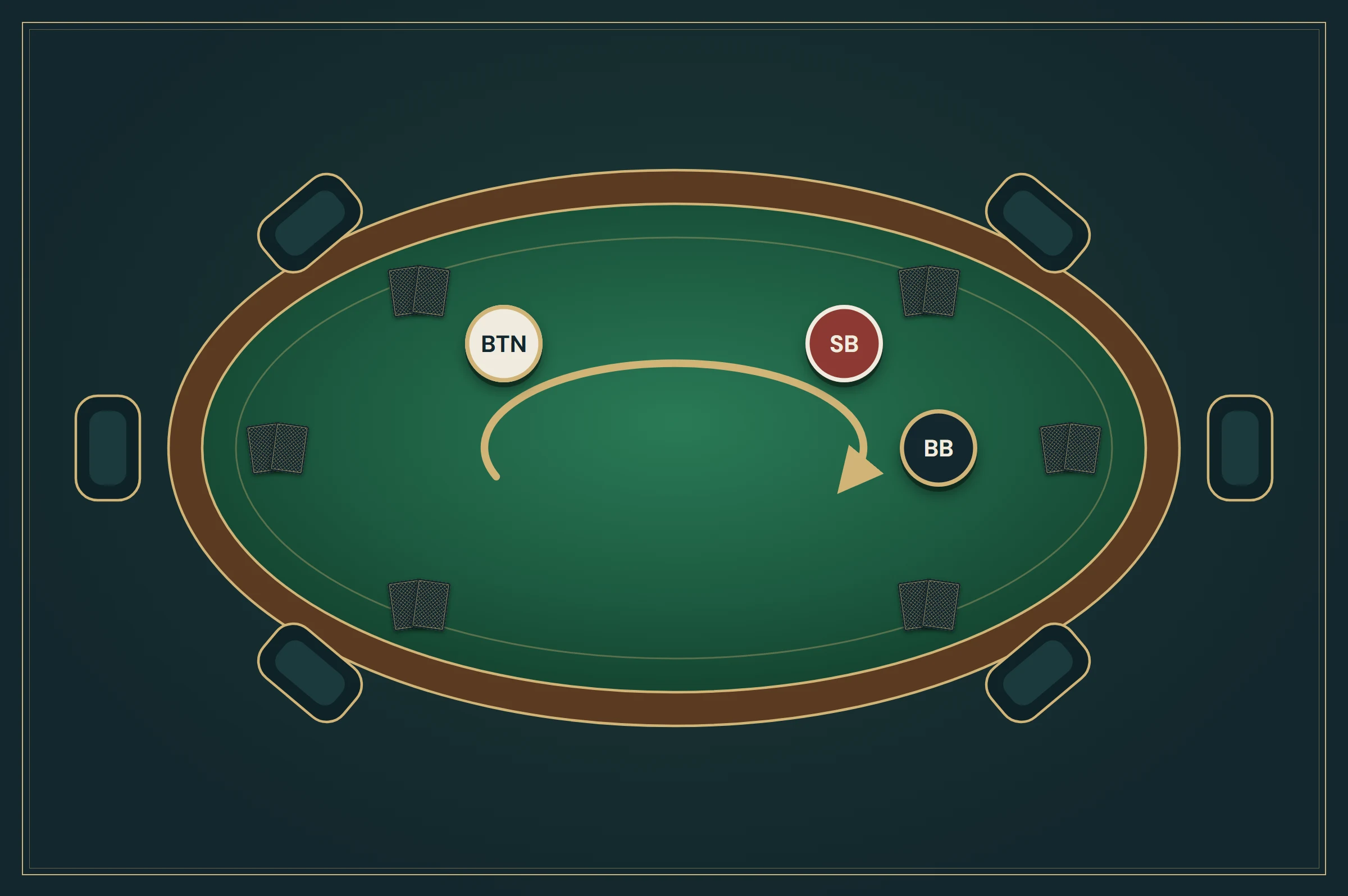
The button marks the dealer’s seat, with the small blind directly to its left and the big blind next to that. After every hand the button moves one seat to the left, so everyone pays the blinds in turn.
The button also decides who acts first. Before the flop, action starts left of the big blind, and after the flop it starts with the first player still in the hand left of the button.
Players tell beginners to pay attention to position, meaning where you sit compared to the button. I’d much rather act last, because I get to see what everyone else did before I decide.
Which Poker Hands Win
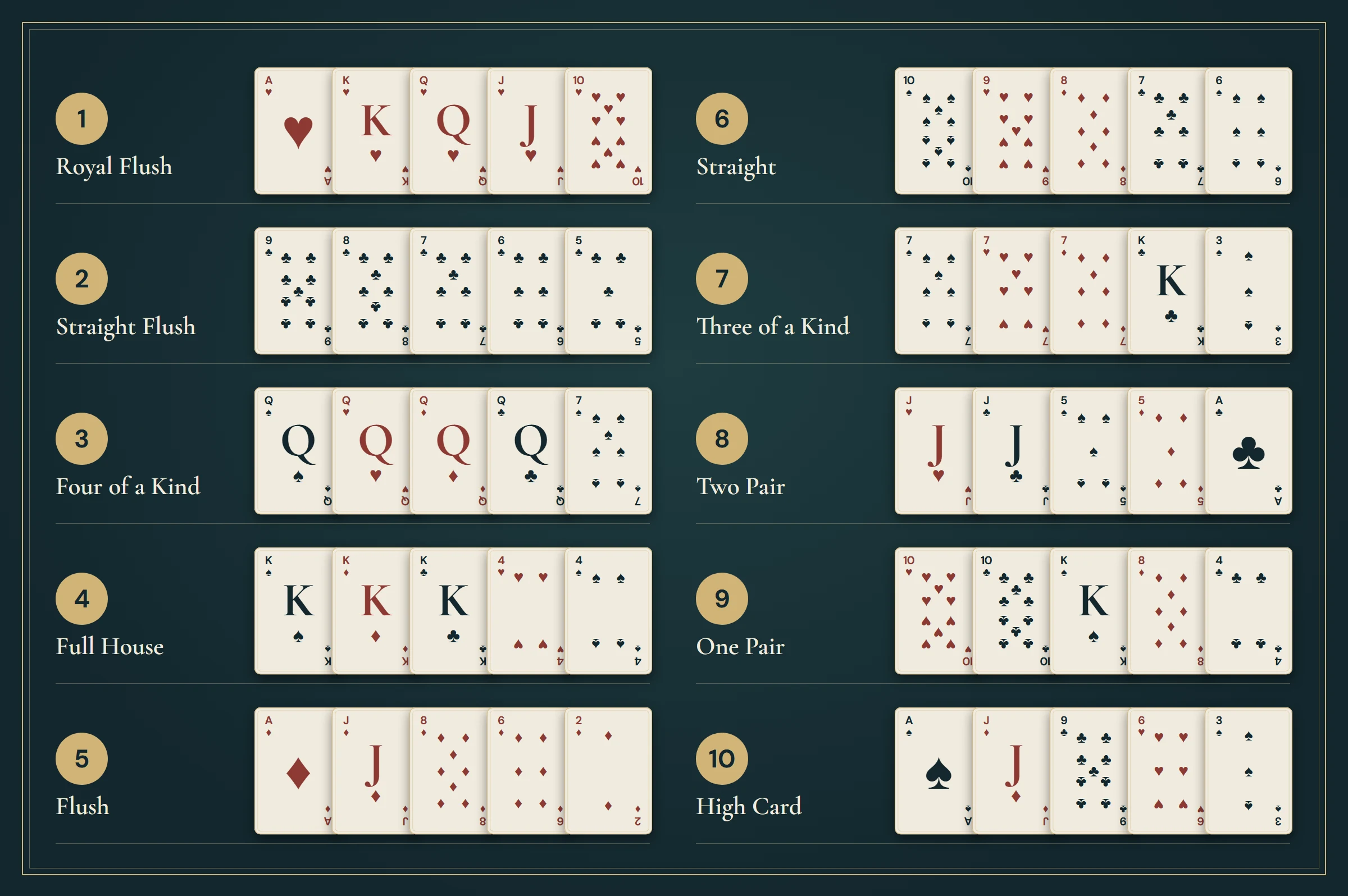
From best to worst, the hands are royal flush, straight flush, four of a kind, full house, flush, straight, three of a kind, two pair, one pair, and high card. The rarer the hand, the higher it ranks.
A royal flush shows up once in 649,740 five-card hands, while one pair shows up about 42% of the time. When two players have the same type of hand, the highest card outside it, called the kicker, breaks the tie. Suits never rank, and if all five cards match, the pot is split.
Lowball games such as Razz flip the order so the lowest hand wins. The poker hand rankings guide covers every tie rule.
Texas Hold’em: Two Hole Cards and Five Shared Cards
Texas Hold’em is the game I’d start every new player on. You get two hole cards, five shared cards come out on the flop, turn, and river, and you make your best hand from any five of the seven. You can use both hole cards, one, or none, which a few beginner guides get wrong.
There are 1,326 possible starting hands in 169 types. You’ll get pocket aces once in 221 hands and any pair about once in 17. No-limit Hold’em runs from $0.01/$0.02 blinds up to $100/$200 at WSOP Online Michigan.
PokerStars on FanDuel lists $0.02/$0.05 to $50/$100, according to Pokerfuse. The Texas Hold’em guide walks through a full hand.
Omaha: Four Hole Cards, and You Must Use Two
Omaha plays like Hold’em, with the same five shared cards and four betting rounds, but you get four hole cards. The big difference is that your hand must use exactly two of them and exactly three from the board.
Hold’em players get this rule wrong more than any other. If you hold four hearts and only one heart is on the board, you don’t have a flush.
Omaha cash tables at WSOP Online Michigan and PokerStars on FanDuel are pot-limit, so the most you can bet is the size of the pot. Online, you’ll also see 5-card and 6-card versions, and the Omaha guide covers both.
Stud Poker: Seven Cards and No Shared Board
Seven Card Stud has no shared cards. Each player gets seven of their own (two face down, four face up, and one more face down), with five betting rounds. Everyone posts an ante instead of blinds, and the player showing the lowest up card has to open the betting with a forced bet called the bring-in.
Stud is fixed-limit: a small bet on the first two rounds, then a big bet (double) after that. The problem for online players is that we couldn’t confirm any licensed US room runs stud tables as of October 2026.
Some game lists name it at a few rooms, but another listing shows none, so check the lobby first. The Seven Card Stud guide has the full rules.
Cash Games vs Tournaments
The first choice in any poker lobby is cash game or tournament, and they play differently.
Cash Games
Pros
- Your chips are real money.
- You pick your buy-in within the table’s range (30 to 100 big blinds at WSOP Online no-limit Hold’em, according to Pokerfuse).
Cons
- The room takes rake from each pot.
Tournaments
Pros
- You pay one buy-in plus a fee, and in a freezeout that’s the most you can lose.
- Payouts are top-heavy, so the top three finishers usually take more than all the other paid players combined.
Cons
- Blinds rise at set times.
- Only roughly 1 player in 10 finishes in the money.
Formats include freezeouts, rebuys, re-entry events, single-table sit and gos, and progressive knockouts. WSOP Online lists multi-table tournaments, single-table sit and gos, BLAST, and satellite events. The poker tournaments guide explains each one.
Rake: What the Poker Room Takes From Each Pot
Rake is the percentage of each cash game pot the room keeps, up to a dollar cap. Regulated US rooms publish rates from 3% to 5.56%, with caps from $0.30 to $5 that rise with the number of players dealt in.
At WSOP Online Michigan, from $0.01/$0.02 up to $2/$5, the room takes $0.01 for every $0.18 in the pot. An $18 pot pays $1.00 in rake, as long as the table’s cap is higher. At $5/$10 and above, the rate drops to 3%.
WSOP Online and BetRivers Poker take no rake when a hand ends before the flop. Tournaments charge a fee instead: 9% on most PokerStars on FanDuel buy-ins under $500, according to Pokerfuse. Rake matters most to beginners at the lowest stakes. The poker rake guide compares the rooms.
Poker Rules: Betting Actions, Limits, and the Showdown
The poker rules that matter in every game are the actions you can take on your turn, the betting limit at your table, and how the showdown is settled. Know these and you can follow any game.
- X
Check
Pass without betting. You can only check when nobody has bet yet in that round.
- B
Bet
Put the first chips in during a betting round. After that, everyone else has to call, raise, or fold.
- C
Call
Match the highest bet so far to stay in the hand.
- R
Raise
Match the highest bet, then make it bigger.
- F
Fold
Give up your cards. You can’t win the pot or act again that hand, but you don’t put in any more money.
- All
All-In
Bet every chip you have when you can’t cover a bet. You can only win up to what you put in, and any extra betting goes into a side pot.
The minimum raise is the rule beginners get wrong most often. A raise has to be at least the size of the last bet or raise in that round, not double the bet. So if the big blind is $2 and someone raises to $6 (a $4 raise), the next player has to raise to at least $10.
| Limit | What It Means | Common In |
|---|---|---|
| No-Limit | You can bet or raise any amount up to your whole stack. | Texas Hold’em (WSOP Online Michigan lists 13 no-limit Hold’em stake levels) |
| Pot-Limit | The most you can bet is the pot, counting the call you make first. With a $10 pot and a $5 bet in front of you, the biggest raise is to $25. | Omaha |
| Fixed-Limit | Bets come in set sizes: a small bet early, then a big bet (double) later, with a cap of one bet plus three raises per round. | Seven Card Stud and limit Hold’em |
At the showdown, the best five-card hand wins and tied hands split the pot. In Hold’em you can play the board, using all five shared cards and none of your own. In Omaha you can’t, because you must use exactly two hole cards.
When a split pot doesn’t divide evenly, WSOP Online gives the odd chip to the winner closest to the dealer’s left. My advice is to learn one game’s rules well before you try another. Start with Hold’em, since nearly all of it carries over to Omaha.
How to Play Online Poker
To play online poker, you need to be 21 or older and physically inside a state with live online poker. Then you sign up at a room licensed in that state, pass an ID check, deposit, and pick a table.
Be Inside a Legal State
The room checks where you are when you log in and while you play, not where you live. It’s the same location check online casinos use, and it blocks play whenever you’re outside the state.
Be 21 or Older
Licensed rooms check your age when you sign up, and every regulated room requires you to be 21 or older.
Create an Account and Verify Your ID
States such as New Jersey and Michigan require the room to confirm your identity and age and to protect the account with a password.
Make a Deposit
Add money through the room’s cashier. The methods on offer depend on the room.
Choose a Game and Stake
Pick a cash table or a tournament. No-limit Hold’em cash games start as low as $0.01/$0.02 blinds, which is where I’d start.
The software deals every hand to real players, and tables are often 6-handed. Every cash table at PokerStars on FanDuel is 6-max, according to Pokerfuse.
Some rooms seat players from more than one state at the same tables, so there are more players to play against. The Michigan Gaming Control Board approved PokerStars on FanDuel for multi-state poker between Michigan, Pennsylvania, and New Jersey. PokerNews reports that WSOP.com pools Nevada, New Jersey, Michigan, and Pennsylvania.
Players point Michigan newcomers to WSOP for that shared pool and its big tournaments, and they report the player pools feel different from room to room.
Poker for beginners at the lowest stakes is tougher than most people expect. Players report tight, careful opponents and rake that’s high compared to the pots. My advice: start at the lowest stakes, play one table at a time, and watch how much rake you pay.
Rooms in the regulated states are licensed by that state’s gaming regulator, and you can contact the regulator if you have a problem with a room.
Online Poker States: Is Online Poker Legal in the US?
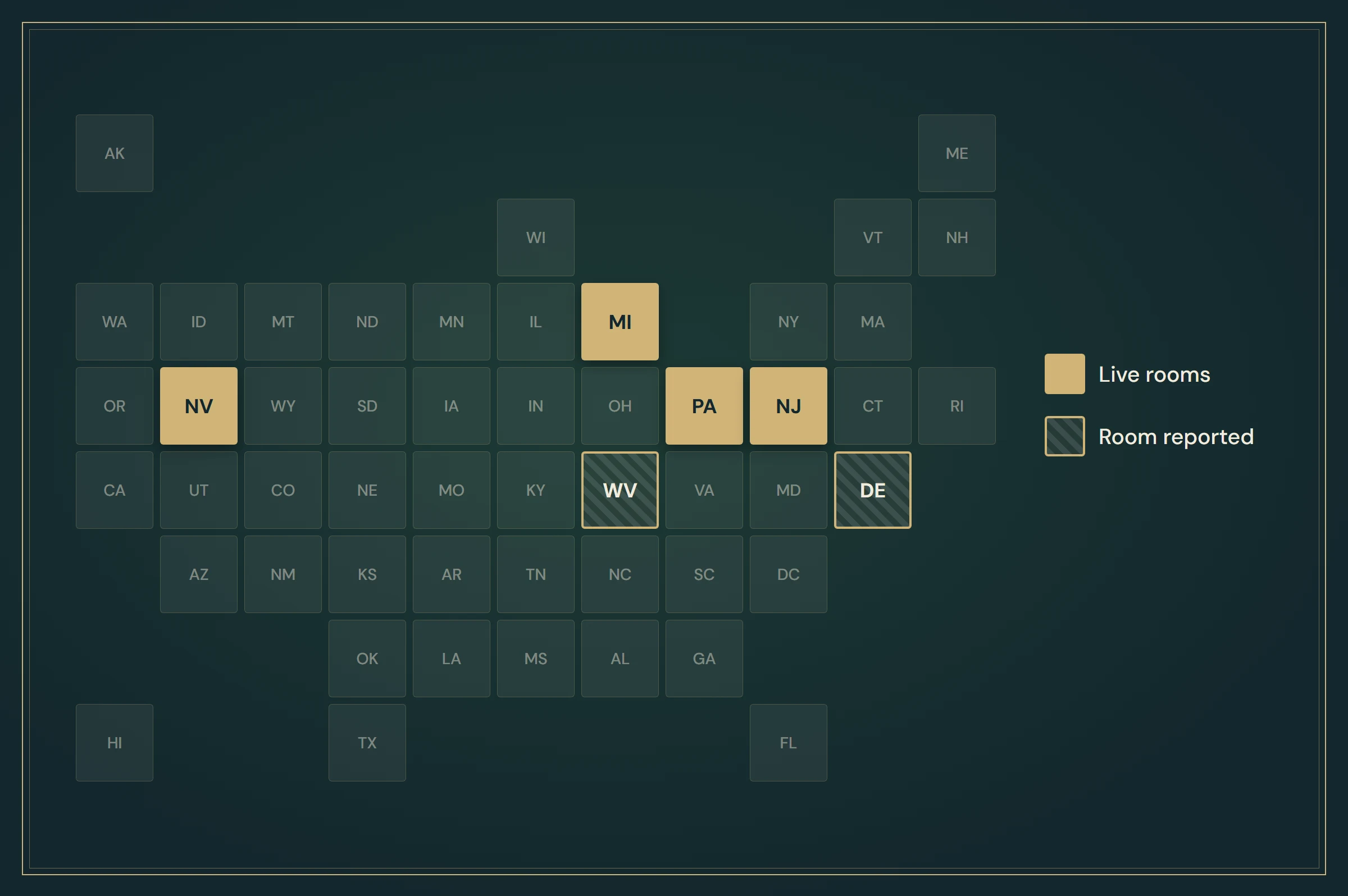
Yes, online poker is legal in the US in states that passed their own online poker law and license poker rooms. Regulated online poker is live in six states as of October 2026. Connecticut, Maine, and Rhode Island have laws that include online poker, but none of them has a live poker room yet.
| State | Regulator | Law | Poker Rooms |
|---|---|---|---|
| Nevada | Nevada Gaming Control Board | AB 114 (2013) | WSOP.com |
| New Jersey | Division of Gaming Enforcement | A2578 (2013) | WSOP.com, BetMGM Poker, Borgata Poker, PokerStars on FanDuel, and DraftKings Poker |
| Pennsylvania | Pennsylvania Gaming Control Board | HB 271 (2017) | WSOP.com, BetMGM Poker, Borgata Poker, PokerStars on FanDuel, BetRivers Poker, and DraftKings Poker |
| Michigan | Michigan Gaming Control Board | Lawful Internet Gaming Act (2019) | WSOP.com, BetMGM Poker, PokerStars on FanDuel, BetRivers Poker, and DraftKings Poker |
| Delaware | Delaware Lottery | HB 333 (2012) | BetRivers Poker (reported) |
| West Virginia | West Virginia Lottery Commission | HB 2934 (2019) | BetRivers Poker (reported) |
Reported: listed by trade press (PokerNews), not confirmed by the state’s lottery. Room lists for New Jersey and Pennsylvania come from PokerNews, plus Covers for DraftKings Poker.
Nevada went first in April 2013, and New Jersey and Delaware followed in November 2013. Pennsylvania’s first poker site opened on November 4, 2019, and Michigan launched in January 2021. In West Virginia, BetRivers Poker reportedly launched in June 2025.
All six states belong to the Multi-State Internet Gaming Agreement (MSIGA), which lets rooms share players across state lines. Michigan joined in 2022. Each room has to join on its own, so not every room pools players across all six states.
The newest room is DraftKings Poker, which launched on July 8, 2026 in Michigan, Pennsylvania, and New Jersey, according to Covers.
Online Poker FAQ
Is poker mostly luck or skill?
Can you play poker with two people?
What are the different types of poker games?
Can I play online poker if I’m visiting a legal state?
How old do you have to be to play online poker?
Is online poker rigged?
What You Can Do Next
If you want to learn poker, these are the steps I’d take, in this order.
- Learn the hand order first, from royal flush down to high card, so you always know what beats what.
- Start with Texas Hold’em, since its rules carry over to Omaha.
- Confirm you’re 21 or older and physically inside one of the six states with live online poker.
- Start at the lowest stakes and keep track of how much rake you pay.
- Set a deposit limit and a time limit before you play. Licensed rooms in states such as New Jersey and Pennsylvania have to offer both.
Sources
Michigan Gaming Control Board, FanDuel multi-state poker release, April 1, 2026 (checked 2026-10-29); WSOP Online Michigan Limits & Rake (checked 2026-10-29); WSOP Online house rules (checked 2026-10-29); WSOP Online Pennsylvania lobby (checked 2026-10-29); PokerStars poker rules, Texas Hold’em rules, and hand rankings (checked 2026-10-29); Robert’s Rules of Poker v5, No-Limit Rule 3 (checked 2026-10-29); Bicycle Cards, Texas Hold’em rules (checked 2026-10-29); PokerNews, Omaha and Seven Card Stud rules and US state poker pages (checked 2026-10-29); Pokerfuse, PokerStars on FanDuel rake and fees breakdown, WSOP rake cap and buy-in rules, and BetRivers Poker rake (checked 2026-10-29); Covers, DraftKings multi-state poker launch (checked 2026-10-29); The Bicycle Hotel & Casino, Seven Card Stud rules (checked 2026-10-29); Wikipedia, Seven-card stud and Poker tournament (checked 2026-10-29); Delaware Lottery iGaming release, November 7, 2013 (checked 2026-10-29); Connecticut Department of Consumer Protection, poker in Connecticut (checked 2026-10-21); PokerNews, Maine online poker law (checked 2026-10-29); N.J.A.C. 13:69O (checked 2026-10-22); 58 Pa. Code 809a and 814a (checked 2026-10-23); Michigan Admin. Code R 432.631 and R 432.655 (checked 2026-10-23); Fortune Scouts calculations, hand and starting-hand counts (checked 2026-10-29).