To play online bingo, you buy one or more boards, the game draws its numbers, and auto-daub marks every hit for you. Complete a winning pattern and the game pays you from its posted paytable. In a bingo hall, you daub by hand and shout “bingo” yourself. Either way, that’s the whole game.
Bingo is one of the few games in the casino world with zero decisions after the buy-in. I mean that literally: no strategy changes which numbers the RNG draws.
So why write a guide at all? Because there’s more variety here than newcomers expect. Online casinos carry two different card formats, the winning patterns change from game to game, and the choices you make before you buy a board really do move your return.
My guide covers how online bingo runs, both card formats, the patterns you’ll actually see, and the honest math on what helps and what doesn’t.
What I Liked And Disliked About Online Bingo
Online bingo is a different experience from playing in a hall. I’ve played both, and there are things online bingo does better and things it does worse.
What I Liked
- Interactive gameplay, so it’s not just a plain board on a screen.
- A lot of game variation for such a simple game.
- You can play anywhere, any time. In person, bingo is only available in bingo halls.
What I Disliked
- The odds have always been horrible for online bingo.
- Payouts are much lower than other lottery-style games.
So that’s the trade-off: online bingo is easier to access and has more variety, but the odds and payouts are worse. I still play it. I just treat it as entertainment, and any win as a bonus.
How Online Bingo Actually Runs
Every game follows the same short loop, and online it takes about a minute.
Pick Your Game
Online lobbies carry dozens of bingo titles across both card formats, and their paytables are not the same. This is the one choice that changes your return.
Buy Your Boards
Most games sell boards from $0.25 to $2 and let you play up to four per draw. Each board is its own entry.
Press Play
The RNG draws the game’s numbers, auto-daub marks every hit on your boards, and any completed pattern pays straight into your balance. No shouting, no verification, no waiting.
A bingo hall runs the same loop with a human caller, paper cards, and a dauber in your hand. Online compresses all of it to a button.
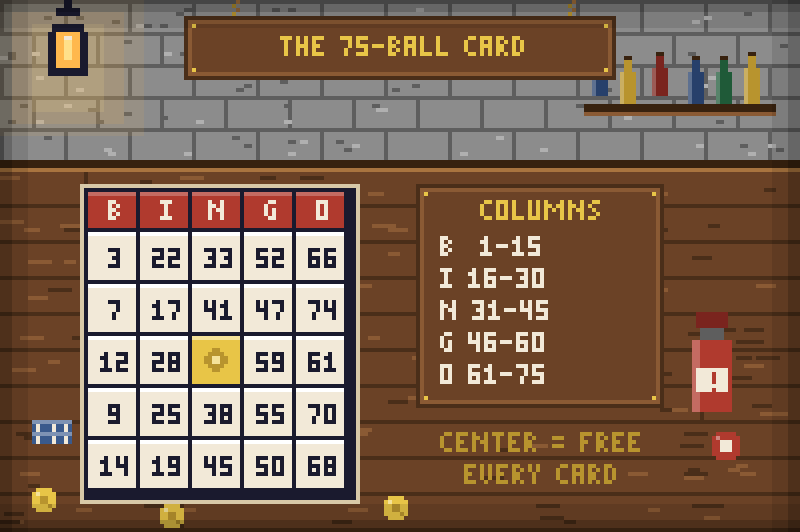
Reading a 75-Ball Card
American bingo runs on a 5×5 card holding 24 numbers and a free center square.
Each column only carries numbers from its own range, and the letters spell the game’s name:
- B1 to 15
- I16 to 30
- N31 to 45 + free space
- G46 to 60
- O61 to 75
Numbers come with their letter attached, “B-7” or “O-64”, so there’s only ever one column to check. Online, auto-daub even does the checking for you. Your free space counts as daubed in any pattern that touches it.
Can you find one number in one column? Then you can play bingo. That’s all the reading a card takes.
75-Ball vs 90-Ball Bingo
Two formats split the bingo world, and they play differently enough to matter.
| 75-Ball (US) | 90-Ball (UK) | |
|---|---|---|
| Card | 5×5 grid, 24 numbers, free center | 9×3 ticket, 15 numbers, 5 per row |
| Number pool | 1 to 75 | 1 to 90 |
| How you win | Complete the announced pattern | One line, two lines, then full house |
| Prizes per game | Usually one | Three, each bigger than the last |
| Pace | Faster games, more pattern variety | Longer games, three chances to win |
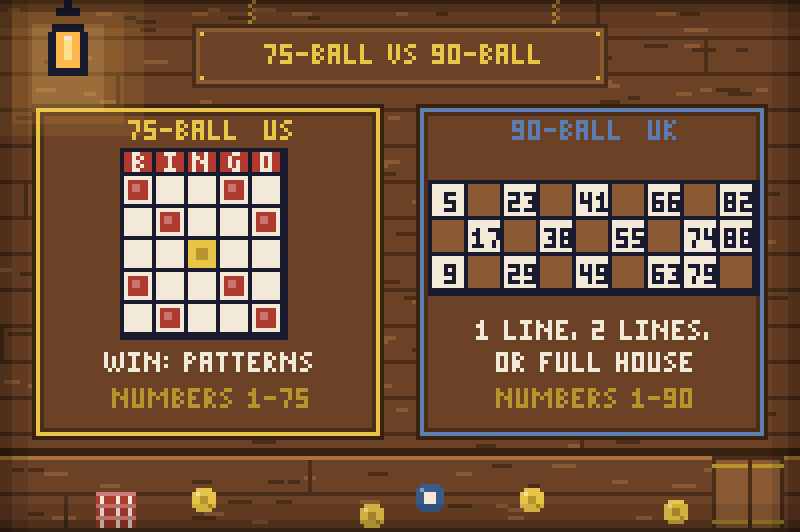
A 90-ball ticket is 9 columns by 3 rows. Each row holds 5 numbers and 4 blanks, 15 numbers in total. One game pays three winners: first to finish any line, first to finish two lines, and first to cover the whole ticket. That last one is the full house, and it pays the most.
So which format should you pick? I lean 75-ball for the pattern variety, but that’s taste, not math. Online casinos carry both, plus speed variants with smaller cards, and the odds logic works the same everywhere.
The Patterns Worth Knowing
75-ball bingo lives on patterns. The game shows its winning pattern before you buy in, and it changes game to game.
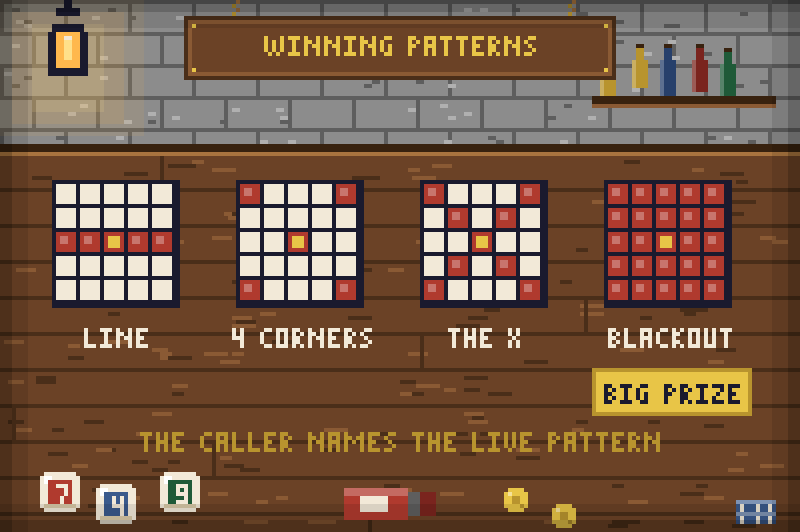
Here are the ones you’ll run into most:
- Any line: five in a row, across, down, or diagonal. The classic game.
- Four corners: just the four corner squares.
- Postage stamp: a 2×2 block in one corner of the card.
- Picture frame: the entire outside edge.
- Letters and shapes: an X, a T, a Z, whatever the program says.
- Coverall (blackout): every square on the card. Slowest game, biggest prize.
The Two Choices That Actually Matter
Online bingo is pure chance. No pick, pattern, or timing changes what the RNG draws. Within that truth, two choices are real.
The game you pick. Two bingo games can charge the same $1 per board and pay very differently for the same catches. The paytable is the price tag, and comparing a few games in the lobby is the entire skill of online bingo. It takes a minute, and it’s the only decision with money attached.
Your boards and your pace. Playing four boards per draw instead of one gives you four chances at that draw and costs four times as much; the return per dollar never moves. What board count really controls is your spend rate. Four $1 boards at a game per minute is $240 an hour, so set the pace on purpose instead of by habit.
750 Boards of Online Bingo
Here’s what three hours of online bingo pays. I set aside $1,000 and played 750 boards of 75-ball video bingo at $1 a board, four boards per draw: 187 full games, plus one last two-board game to make it a clean 750.
This was the RNG version, so no other players and no shared prize pool. Every board played against the same posted paytable, and I tracked what every one of them did.
The game I played:
- 75-ballVideo bingo, RNG version
- $1Per board, 4 boards per game
- 30 ballsDrawn each game, all boards at once
- $3 / $20 / $100Pays for 1, 2, and 3 lines
- ~1 minPer game
Here’s how all 750 boards finished. Green paid, gold came up one number short, and crimson never got close:
| Outcome | Boards | Share of 750 |
|---|---|---|
| Three lines | 1 | 0.1% |
| Two lines | 6 | 0.8% |
| One line | 86 | 11.5% |
| One number short of a line | 463 | 61.7% |
| Nothing | 194 | 25.9% |
93 boards paid something, about one board in eight. Here’s what those wins added up to:
| Result | Pays per $1 board | Boards that hit | Paid me |
|---|---|---|---|
| One line | $3 | 86 | $258 |
| Two lines | $20 | 6 | $120 |
| Three lines | $100 | 1 | $100 |
| Total | 93 | $478 |
My best moment came at game 62. One board completed three lines on a single draw, and another board added a line on top: $103 from one game. My worst stretch ran 13 straight games, 52 boards, without a single line.
- $1,000Starting bankroll
- $750Total spent
- $478Total won
- $728Final bankroll
The session cost me $272. That’s 63.7 cents returned per dollar, in a game whose long-run math returns about 70. Nothing unusual happened; I simply ran a little under average, and in bingo that’s expensive. Seven cents per dollar sounds small until you multiply it: across $750 in boards, an ordinary below-average night cost me an extra $47 on top of the game’s built-in 30% price.
That’s the part worth understanding about online bingo. The posted return is a long-run average, and it needs thousands of games to show up. When the starting point is only 70%, a normal night can land you in the low 60s. For comparison, a below-average night at blackjack starts from a 99.5% baseline. A below-average night at online bingo starts from 70% and drops from there.
Two Things The Numbers Show
Winning boards were common; winning money wasn’t. 93 boards paid something, but 86 of them paid the $3 minimum. Frequent small line wins are the game returning your own money slowly, while the real payouts sit on double and triple lines I hit 7 times in three hours. That’s the trade you accept in any lottery-style game.
463 of my 750 boards, more than six in ten, ended one number short of a line. The game is built to look close. A board that misses by one number pays the same as a board that misses by ten, and this game produced 463 of them in one evening. Keep that in mind through the next section.
The Hot Numbers Myth
Nearly every online bingo game displays which numbers have hit most often. Players study those boards, hunting for hot numbers or numbers that feel “due”.
Do the boards ever help? No. Every draw starts fresh, and B-7 hitting three games in a row tells you nothing about game four. The boards are entertainment, not information.
This is the bingo version of the baccarat scoreboard. Casinos learned long ago that players enjoy a feeling of control, so they hand the data over happily. I treat those boards as decoration. Enjoy the ritual if you like it, but never pay extra because of it.
Bingo Halls vs Online Bingo
So which is the better way to play? Wrong question. The screen and the hall run the same game and deliver completely different nights.
Online Bingo
Pros
- Games run around the clock, with boards from about $0.25.
- Auto-daub never misses, and a full game fits in a minute.
- Dozens of titles and both card formats in one lobby.
Cons
- The game does most of the playing for you.
- Some nights it feels like watching your boards report in.
- No crowd, no caller, no shared moment when someone hits.
Bingo Halls
Pros
- A real event: paper cards, a dauber, a caller with a microphone.
- A room full of people racing you to the same pattern.
- A win feels bigger with an audience.
Cons
- You travel, and you play on the hall’s schedule.
- The pace is slower and a missed number stays missed.
If you do try a hall night, three habits keep you welcome: arrive before the first call, shout your bingo the moment you complete the pattern (a late call can be ruled dead), and tip the caller a few dollars after a win.
I’d point a first-timer at a free online game to learn the flow, and at a real hall at least once to see why people love this game.
Common Questions About Bingo
How do you play bingo step by step?
What is the difference between 75-ball and 90-ball bingo?
How can you improve your chances of winning at bingo?
What are the most common bingo patterns?
Is online bingo the same game?
Why are online bingo payouts so low?
Where to Go From Here
You now know how online bingo runs, how to read both card types, and the two choices that actually matter: the game’s paytable and your pace.
Start cheap while you learn:
- Play a few free demo games first to learn the rhythm
- Compare paytables before you buy a single board
- Start with one or two boards per draw, not four
- Treat the hot-numbers board as decoration
- Save a bingo hall night for when you want the social version