
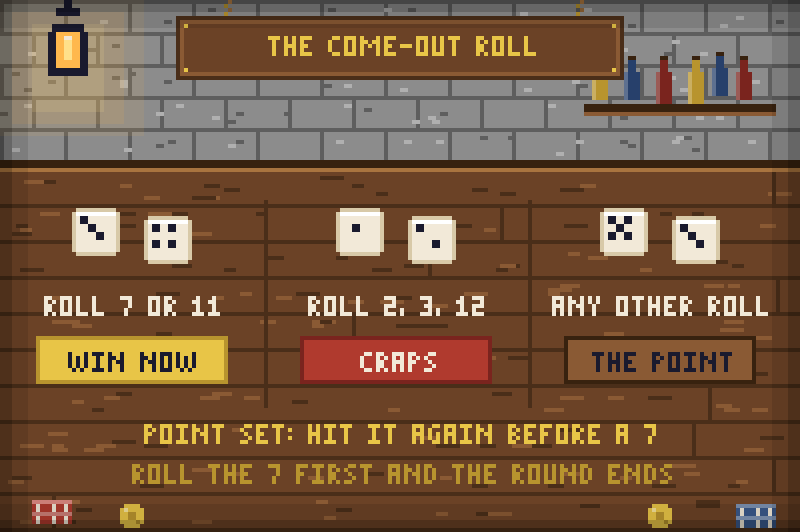
To play craps, you bet on dice rolls. The first roll of a round either wins pass-line bets instantly (7 or 11), loses them instantly (2, 3, or 12), or sets a point number. Once a point is set, one question decides everything: does the point repeat before a 7 shows? Bet the pass line, back it with free odds, and you’re playing a combined house edge around 0.37%, one of the best bets in the casino.
The craps layout looks like chaos even on a screen: dozens of betting zones with names like “hardways” and “the horn”, all crammed onto one board.
Sound complicated? It isn’t. Underneath the clutter sits one simple loop and a pile of side bets you can ignore forever. Two bets carry the entire game, and online they’re the two biggest areas on the layout.
My guide walks you through the loop, the two bets worth making, the traps in the center, and how the online version compares to the loud table at a casino.
What I Liked And Disliked About Online Craps
Craps is the game I most recommend playing in person, so I judge the online version against a high standard. Some of it holds up. Some of it doesn’t.
What I Liked
- Simpler layout. Placing a bet takes one tap instead of a reach across a crowded table.
- The payouts and odds are great when you bet smart.
What I Disliked
- Not as fun as the real thing. It’s a flat board with interactive dice.
- Rules and strategy are on you. In person, dealers and other players help you out.
For me that trade points one direction: online craps is where you learn and practice, and the live table is where the game is at its best. The math is identical in both places.
The Core Loop: Come-Out, Point, Seven
Every round of craps starts with a come-out roll.
Come-Out Roll
A 7 or 11 is a natural: pass-line bets win even money on the spot. A 2, 3, or 12 is craps: pass-line bets lose.
The Point Is Set
Any other number (4, 5, 6, 8, 9, or 10) becomes the point, and a puck flips to ON above it. Online, the software handles the puck for you.
Point or Seven
The rolls continue until the point repeats (pass line wins) or a 7 lands (pass line loses). That losing 7 is called sevening out. At a live table it passes the dice to the next shooter; online, the next round simply starts.
That’s the whole engine. Every other bet on the layout is a side wager riding on top of it, which is why you can play excellent craps while understanding a tenth of the board.
The Layout Without the Fear
Online craps shows you the same layout a casino table uses, minus the crowd pressing against it.
The two areas you need sit closest to you: the pass line and the don’t pass bar run the length of the board, with the empty space behind them where odds bets go. Everything exotic fills the center block of the screen, and you’ll learn to scroll right past it.
Betting takes two taps: pick a chip size, tap the zone. The software only accepts bets at legal moments, pays every win to the cent, and an undo button fixes a misclick before the roll. Nobody is waiting on you, so take whatever time you need.
The Only Two Bets You Need
A beginner playing pass line with odds is making a better bet than most veterans in the room.
The pass line comes first. Place chips on it before a come-out roll and you win even money when the roll wins. On its own, it carries a 1.41% house edge, already better than most of the casino floor.
Free odds are why craps is worth learning. After a point is set, you can place extra chips behind your pass-line bet. That back bet pays true odds, and the house edge on it is zero. Not low. Zero, the only bet in the casino with none.
- 2:1Odds payout on point 4 or 10
- 3:2Odds payout on point 5 or 9
- 6:5Odds payout on point 6 or 8
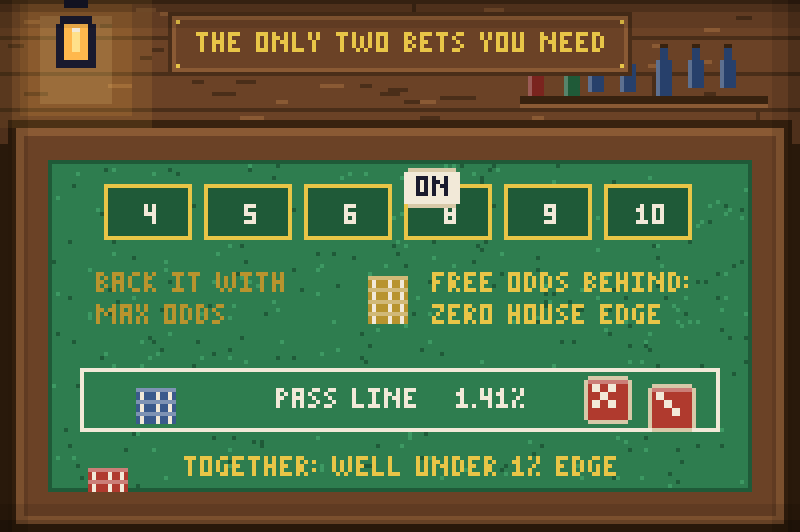
Why would a casino offer a bet it can’t win on? Because you can only place it after making the line bet, which is where the house collects its edge. Tables also cap odds at a multiple of your pass bet, commonly listed as 3-4-5x. Backing a $10 pass bet with full odds drops your combined edge to about 0.37%; that’s an expected cost of under 4 cents per round.
Here’s a full example.
You bet $10 on the pass line, and the come-out rolls a 4. You put $30 behind it. The next rolls come 9, then 11, then the 4. The pass line pays $10, and the odds pay $60 at 2:1. One 7 before that 4 and both bets would have gone to the house; that risk is why the odds price is fair.
The don’t pass line is the mirror bet: it wins when the table loses, at a 1.36% edge, or around 0.27% with odds. Its math is slightly better. Its problem is social: at a live table you’re cheering against everyone else at the rail. I bet the pass line and keep my friends. Online, that objection disappears, and the test later in this page shows what happened when I finally bet don’t pass for a full session.
Bets to Handle With Care
A middle tier of bets sits between the two good ones and the traps.
Come bets work exactly like a pass-line bet started mid-round, odds and all. Same fair price, more things to track at once. Learn them in your second session, not your first.
Placing the 6 or 8 pays $7 per $6 bet at a 1.52% edge, the least bad of the place bets. Fine in small doses when you want more numbers working.
The field looks friendly and isn’t. Seven winning numbers on one roll sounds generous until you notice the missing ones: 5, 6, 7, and 8, the most common totals in dice. The edge runs about 5.6% on most layouts. I skip it every time.
The Center of the Board Is a Trap
Those exotic bets filling the middle of the layout? That’s where the casino makes its craps money.
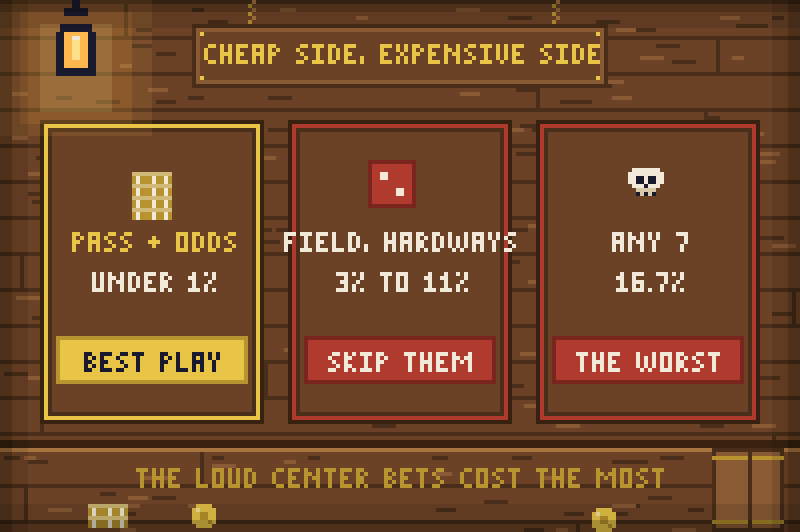
Any seven pays 4:1 on a bet that should pay 5:1, a 16.67% house edge and the worst standard bet in the building. Any craps holds an 11.1% edge. The hardways, betting a number lands as a perfect pair, run 9.1% to 11.1%.
At a live table, the stickman announces these all night and makes them sound fun. Online nobody sells them out loud; the sale is the layout itself, big bright squares sitting one tap away, and some RNG tables stack extra side bets on top. Same trap either way.
Skip the center. All of it, forever.
House Edge by Bet
Every craps bet, from the ones worth your chips to the ones that empty them:
| Bet | House edge | Verdict |
|---|---|---|
| Pass line + full 3-4-5x odds | ~0.37% | The bet to build on |
| Don’t pass + odds | ~0.27% | Slightly cheaper, socially costly |
| Pass line alone | 1.41% | Good, better with odds |
| Don’t pass alone | 1.36% | Good, better with odds |
| Place the 6 or 8 | 1.52% | Fine in small doses |
| Field | ~5.6% | Skip it |
| Any craps | 11.1% | Skip it |
| Hardways | 9.1% to 11.1% | Skip them |
| Any seven | 16.67% | The worst bet on the table |
The gap between the top and bottom of that table is the entire skill of craps. You can’t control the dice; you completely control which line your chips sit on.
360 Rounds of Online Craps
Online craps let me do something I never do at a live table: bet against the shooter. Earlier I said I bet the pass line and keep my friends. Online, there are no friends to keep, so for three hours I finally played the bet the math likes best.
The session: 360 rounds of RNG craps, ten for every way two dice can land, at $10 on don’t pass every round. After each point was set, I laid odds sized to win an extra $10: $20 against a 4 or 10, $15 against a 5 or 9, $12 against a 6 or 8. You lay more than you win back because the 7 is the favorite; in exchange, the house edge on the lay portion is zero. I started with a $1,000 bankroll.
The setup:
- $10On don’t pass, every round
- $20/$15/$12Laid to win $10 after each point
- 360Rounds, about 30 seconds each
- RNGNo crew, no crowd, no dice etiquette
Here’s how the 360 rounds broke down. Green rounds paid me, crimson rounds paid the house, and gold pushed:
| Result | Rounds | Money |
|---|---|---|
| Point set, then a 7: won flat bet plus odds | 151 | +$3,020 |
| The point repeated: lost flat bet plus lay | 92 | -$2,266 |
| Come-out 7 or 11: instant loss | 71 | -$710 |
| Come-out 2 or 3: instant win | 36 | +$360 |
| Come-out 12: push | 10 | $0 |
| Total | 360 | +$404 |
Once a point was set, I was the favorite every single time. Here’s that part of the night on its own:
| Point | My lay | The odds say | My record |
|---|---|---|---|
| 4 or 10 | $20 to win $10 | I win 2 in 3 | Won 43, lost 19 |
| 5 or 9 | $15 to win $10 | I win 3 in 5 | Won 47, lost 30 |
| 6 or 8 | $12 to win $10 | I win 6 in 11 | Won 61, lost 43 |
The night had two halves. My worst stretch, six straight losing rounds for $139, came early, and by round 74 I was down $282. The climb back took the rest of the session, including a run of eight straight winning rounds worth $150. And the strangest number of the night was 10: that’s how many come-out rolls landed on 12, where my bet just gets returned. That one rule, the bar 12, is exactly what keeps don’t pass from being an even-money proposition.
- $1,000Starting bankroll
- $7,243Total wagered
- $7,647Total won back
- $1,404Final bankroll
Look at those numbers next to each other. I put $7,243 through the game in three hours, $3,600 in flat bets plus $3,643 in lay odds, and walked away $404 ahead. Now the honest part: the math expected me to lose about $49 on this session. Everything past that is variance landing on my side of the line, not skill. The same dice were one bad stretch away from handing me the mirror image.
Two Things The Numbers Show
The come-out roll is where the don’t side pays. My come-out record was 36 wins, 71 losses, and 10 pushes: $350 gone before any point was set. After a point was set I went 151 and 92 as the favorite, worth $754 back. Betting don’t pass means losing small and often early, then collecting later; on this night the late part outran the early part.
A $404 profit doesn’t mean I beat craps. The edge sets the price per dollar; the dice set the night, and at a bet this close to even, nearly half of all sessions end ahead. Compare that to my bingo test: at a 30% edge, a winning three-hour session barely exists. Picking the cheap game is what gave luck room to pay me at all.
Your First Five Minutes of Online Craps
Here’s how I’d start a first session, in order.
Open the Demo
Most RNG craps games run in free-play mode, so the whole loop can be learned at zero cost. Play until the come-out, the point, and the puck make sense without reading anything.
Find Your Two Bets
The pass line and don’t pass bar sit along the near edge of the layout, the largest zones on the screen. The odds space is directly behind them.
Place and Roll
Pick a chip size, tap the pass line, press roll. When a point is set, tap the space behind your bet to add odds. The game won’t accept an odds bet at the wrong time, so you can’t misfire.
Watch the Rebet Button
“Rebet and roll” repeats your last bets and throws instantly. Convenient, and it quietly sets your pace faster than you’d ever bet on your own. At $10 a round plus odds, a tap every few seconds moves serious money. Decide your pace; don’t let a button decide it.
Craps at the Casino vs Online
The live table is the full version of craps. Between the noise, the shared sweat on a long roll, and the stranger high-fiving you over a $10 win, no other casino game builds a room like it. Entry costs real money, though, with $10 to $15 minimums plus odds money behind them.
Online RNG craps plays like an app: instant rolls, $1 bets, free demo modes, and you’re the shooter every round. Live-dealer craps streams a real table with real dice and lands in between. Bubble craps, the electronic dome machines at casinos, is a quieter, cheaper way to play the same game in person.
My advice runs one direction. Learn the bets online for free, then go stand at a real table at least once, because no other casino game depends this much on the people around the table.
Common Questions About Craps
What is the best craps strategy for beginners?
What is the smartest bet in craps?
What are the most common craps mistakes?
What is the 6-7-8 craps strategy?
What should you not do at a craps table?
What number hits the most in craps?
Where to Go From Here
You now know the loop, the two bets, and the only numbers that matter: 0.37% on the line with odds, 16.67% in the center.
Keep your first sessions simple:
- Learn the loop in a free demo game before betting a dollar
- Bet the pass line or don’t pass, then back it with odds
- Add a place bet on the 6 or 8 only when you want more action
- Skip the center of the board and every side bet
- Set your own pace; don’t let the rebet button set it