To play blackjack, you try to build a hand worth more than the dealers without going over 21. You’re dealt two cards, then you choose to take more (hit), split or double, or stop (stand). Beat the dealers hand and you win. Go over 21 and you bust (lose immediately).
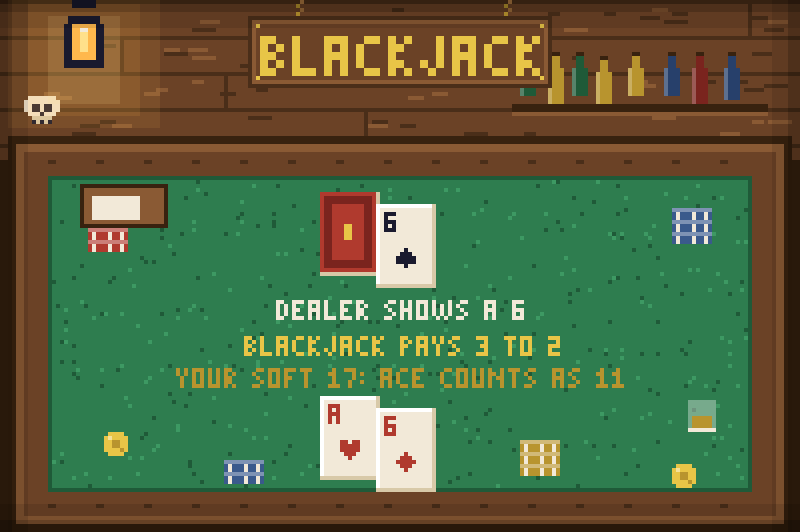
Don’t treat online blackjack like a race to reach twenty-one. Keep taking cards and you’ll just end up busting. There is more to playing blackjack.
You don’t really need a 21. You simply need a hand that is higher than the dealers without going over 21. Sometimes that’s a 20, other times a 17, 18, or even a 12. All that matters is you did not bust and beat the dealer.
The game of blackjack comes down to one question: is my hand likely to beat the dealers, or do I take another card and risk it?
My guide helps answer that question, using real experience at the table and online. You’ll learn what a round looks like from the deal to the payout, the choices you can make, and things you can skip. Playing well can lower the house edge to about 0.5%. But it can never remove it entirely.
What I Liked And Disliked About Online Blackjack
I have played blackjack for over 20 years; with the past 8 years online. I’ve gone through enough hands, and money, to gain first-hand experience. Here are my thoughts on playing blackjack online.
What I Liked
- Fast gameplay, run through hands quicker.
- Low betting limits; $1 tables.
- Dozens of blackjack variations with interesting twists.
- Most tables have decent rules.
What I Disliked
- RNG shuffled every hand, so every deal acts like a fresh deck.
- The house edge feels inconsistent, even in longer sessions.
- Side bets and their odds are horrible.
Value of Blackjack Cards
Each deck has 52 cards, with each card having their specific value. Despite this, their values are straightforward and simple to understand.
Blackjack card values fall into three categories.
- 2–10
Number Cards
Worth their face value. A 7 is worth 7
- J Q K
Face Cards
Always worth 10, the most common value in the deck.
- A
The Ace
1 or 11, whichever helps your hand.
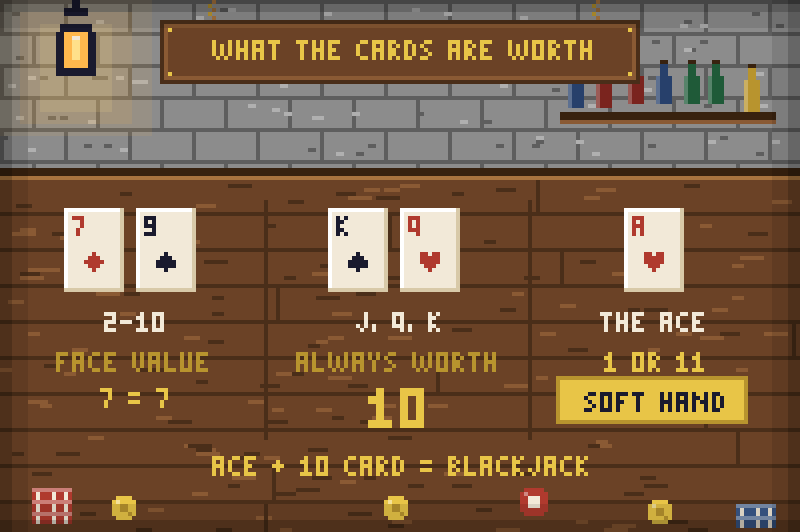
The Ace is a special card, as it comes with two potential values. The two values of an Ace is 11 or 1, depending on the situation. The Ace counts as 11 until the value could “bust you”. Then it simply reverts to a 1.
For example, if you start with an Ace and 5, that is 11 + 5 = 16. You hit and take another card and pull a King, that would “bust” a 16, but with the Ace reverting to a 1, it now becomes 1 + 5 + 10 = 16. These two types of hands are called soft and hard.
What is a “blackjack” then? That’s an Ace plus any 10-value card on your first two cards. It’s THE hand to get in blackjack, and it pays more. The payout matters, as it can affect the the house edge and how much money you canwin over time.
How a Blackjack Hand Actually Plays Out
Every player at the table is against the dealer, never against each other.
The only time a player becomes an issue is when they make a dumb decision that affects your own.
Bet & Deal
Two cards dealt to you, two to the dealer. One of the dealers card is face up. That upcard will be your biggest clue.
Your Turn
Take more cards, bet, or stop. Every choice you make affects your hand against the dealers upcard.
Dealer Draws
The dealer has to follow the table rules. Drawing until they reach at least 17 (soft or hard).
Showdown
The higher hand wins. Tie is a push, and you keep your bet. You bust, you lose.
One dealer card sits face up (the “upcard”), the other stays face down until the dealers turn. Once every player has finished, the dealer flips the hidden card and plays their hand. They play regardless of the hand they have. Even if their current hand beats yours, if they have less than 17, they have to hit.
Then all hands are compared with the dealers. Beat the dealer and you win. Tie and it’s a push, where you keep your bet. Most players may view a push as a negative, I like to view them as another chance to double my winnings.
The Five Decisions You Can Make
Once it’s your turn, you have a choices you can make. These are the five player choices important when learning to play blackjack.
- +1
Hit
Take another card.
You can hit as much as you want, until you stop or bust.
- 17
Stand
Take no more cards and lock in your hand.
- 2×
Double
Place extra bet for one extra card.
This can double your win, a strong move on an 11.
- 8|8
Split
Turn “any” pair into two separate hands with a second bet.
Some pairs are effective, others do not.
- ½
Surrender
Fold a bad hand at the cost of half your bet.
Not offered online, rarely found at land-based casinos.
A few of these decisions have publicly acknowledged rules.
- Always split Aces and 8s.
- Never split 10s or 5s.
- Always double on 11, except if dealer is showing Ace or 10.
These have been long thought of as good plays based on most common outcomes.
At a real table you signal these with your hands instead of saying them out loud.
- 👆
Hit
Tap the felt to get another card.
- 👋
Stand
Wave a flat hand over your cards to stand.
- ✌️
Double
Use two fingers to point at your hand to double down.
- 🙌
Split
Similar to double, point to your cards with both hands.
- 👇
Surrender
Swipe your finger across the felt.
Insurance and Even-Money Offer
When the dealers upcard is an ace, the dealer will ask you if you want “insurance”.
Insurance is a side bet meant to lessen your loss if the dealer ends up with a blackjack. It pays 2:1 if they do. It may sound like a good idea to protect your hand.
However, between the odds of a dealer having a blackjack and long-term payouts, insurance is a losing bet.
You’ll sometimes hear “even money”; mostly at land-based casinos. This is not an option you will find online.
That’s the same bet dressed up: if you have a blackjack and the dealer shows an ace, they offer to pay you 1:1 right away. The idea is that if the dealer also has a blackjack, you end up pushing.
If you take the offer, you give up a portion of blackjacks payout. I recommend you decline and let the hand play out. At worst you do push, at best you get your blackjack pay out. Either way, over time you lose out on more winnings than what you would earn with even money.
Basic Strategy: The Few Rules Worth Memorizing
Blackjack is the rare casino game where your choices actually change your odds.
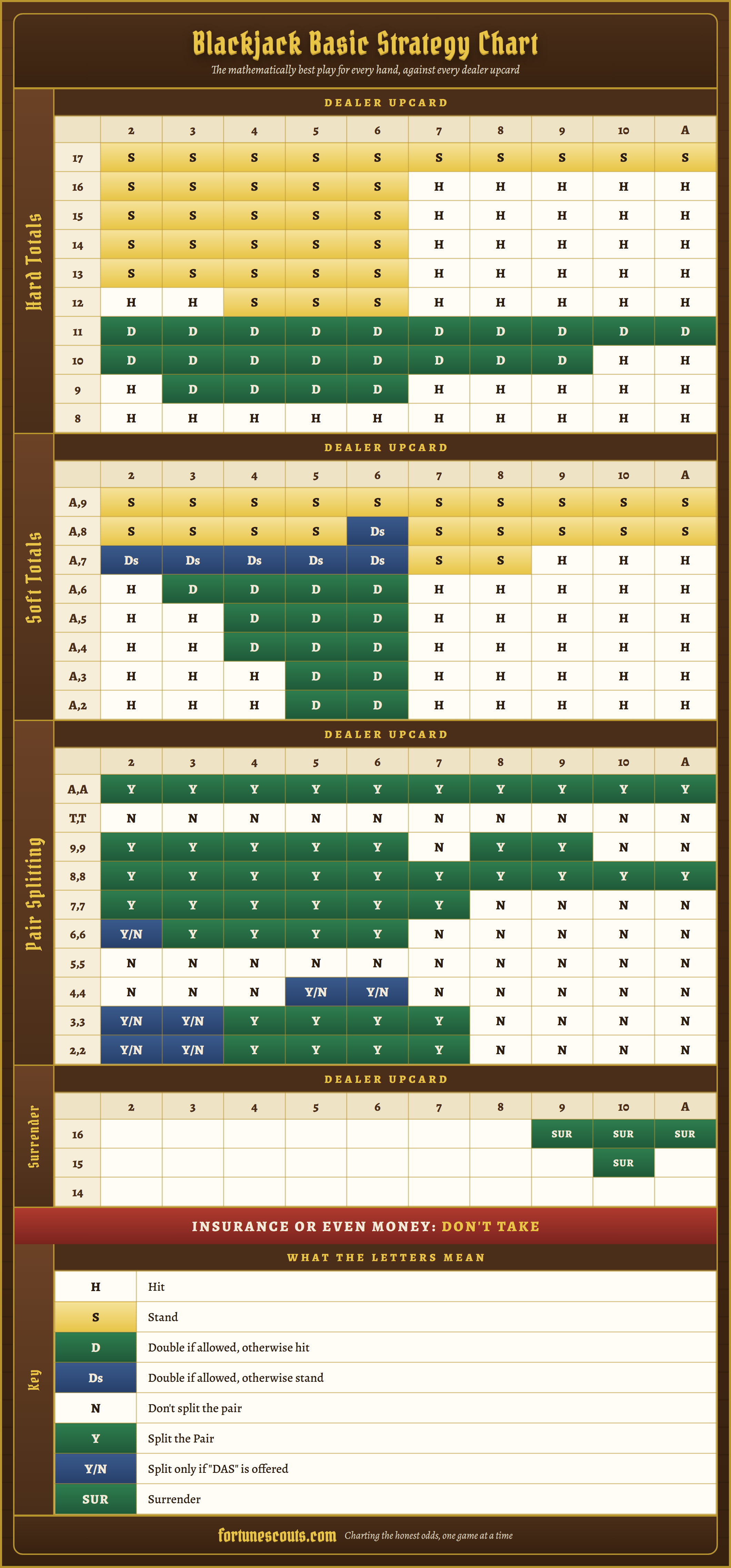
Basic strategy is the map of the most optimal player decisions. The strategy is the mathematical best play for every hand you have against every dealer upcard.
Smart players learn and use it, rather than relying on a gut feeling. If you play at a casino, you can take your strategy card with you. Keep our strategy card with you as you play blackjack online. No need to memorize it all at the start, you’ll pick up it as you play.
Use our one-page blackjack basic strategy chart:
Dealer Face-Down Card Assumption
Two quick examples of strategy and face-down card rule:
Special note: Card counting is the only method to beat the house edge. You can’t count cards when playing online blackjack, only on the casino floor.
One-Thousand Hands of Blackjack
Reading about the odds is one thing and I have always been one to take action. I wanted to see how the odds and gameplay went down when playing classic online blackjack.
So I ran a test: 1,001 hands of online blackjack at $10 a hand, spread over two 2-hour sessions. I recorded every outcome, and uses basic strategy the entire time. No hunches, no side bets, no bet changes.
The table I played at:
- 6 decksClassic blackjack
- 3:2Blackjack payout
- $1–$100Table limits
- Soft 17Dealer hits on soft 17
Here’s how all of my 1,001 hands ended up going. Solid green bars are hands I won, striped crimson bars are hands I lost, and gold is a push:
| Outcome | Result | Hands | Share of 1,001 |
|---|---|---|---|
| Dealer beat me | Loss | 290 | 29.0% |
| I beat the dealer | Win | 201 | 20.1% |
| Dealer busted | Win | 190 | 19.0% |
| I busted | Loss | 140 | 14.0% |
| Push | Push | 88 | 8.8% |
| Dealer blackjack | Loss | 47 | 4.7% |
| My blackjack | Win | 45 | 4.5% |
And here’s what basic strategy had me doing. One first decision per hand, 1,001 in total:
| My first move | Hands | Share of 1,001 |
|---|---|---|
| Hit | 486 | 48.6% |
| Stand | 342 | 34.2% |
| Double down | 118 | 11.8% |
| Split | 55 | 5.5% |
I played with a $1,000 bankroll. This would give me a minimum of 100 hands if I lost every time. I took the chance on being able to win more often than losing. I didn’t end up with a profit, but I didn’t lose my entire bankroll either.
- $5,325Total won
- $5,610Total lost
- $715Final bankroll
Adding everything up and I won 436 of 1,001 hands. That’s a 43.6% win rate, and it cost me $285.
Honestly, that’s a better run than normal for me. The longer my sessions go, the further that win rate tends to drop. That’s the house edge doing exactly what the math says it will.
I also bet a flat $10 the whole way. Varying your bets can improve a hot streak, so be strategic of when to increase your bets. Why? This can just as easily lose your bankroll.
Two More Things The Numbers Show
The dealer did almost half of my winning for me. 190 of my 436 wins came from the dealer busting, not from me making a stronger hand. Basic strategy had me stand on weaker hands against weak upcards.
Blackjacks came out near even: 45 for me, 47 for the dealer. The deck played no favorites. What the 3:2 payout did was soften the damage. Those 45 blackjacks paid me $675. On a 6:5 table, the same cards would only pay $540. This run would have cost me $420 instead of $285.
What the House Edge Really Is
- ~0.5%House edge with basic strategy
- 3:2The payout worth sitting down for
- 3×What a 6:5 table can cost you
There is roughly a 0.5% house edge on a player-friendly blackjack game when you use basic strategy. It’s one of the lowest edges on the casino floor. It does not mean you’ll always win. It means blackjack takes less from you per hand than most other games. And if you play it right, you may walk away with some extra money in your pocket.
A few table rules can change the house edge. One is the payout on a blackjack. The old standard pays 3:2. Plenty of tables now pay only 6:5. This is what it does to the same winning blackjack:
- 3:2A $100 blackjack pays $150Play Here
- 6:5The same hand pays only $120Walk Past
| Blackjack payout | A $100 blackjack pays | Effect on the house edge |
|---|---|---|
| 3:2 (the good table) | $150 | The baseline, around 0.5% |
| 6:5 (the bad table) | $120 | Adds well over a full percentage point |
The example is only a difference of $30 and that may look small. It isn’t. Moving from 3:2 to 6:5 can more than triple what the game costs you over time, on the exact same cards.
So the single most useful habit at a real table has nothing to do with card counting. Check the table for “blackjack pays 3:2” and walk past the 6:5 tables.
Online Blackjack vs Land-Based
Which version should you actually play? After playing each for years, I have come to know and appreciate them both.
Online Blackjack
Pros
- Easy access. You’re dealt in from your couch in under a minute.
- Dozens of games in one lobby.
- Low betting limits, with tables from $1.
Cons
- The house edge is usually worse, thanks to 6:5 payouts and gimmick rules.
- Card counting is off the table.
- The RNG forces a full reshuffle every hand.
Land-Based Blackjack
Pros
- The house edge is more reliable from table to table.
- Higher community energy. A hot shoe with a full table is hard to beat.
Cons
- You have to travel to get there.
- Table limits run high, and $15 or $25 minimums add up fast.
- Low variety compared to an online lobby.
So which one is better? Neither. Both.
They’re two different types of experiences. Online gives you speed, choices, and lower bets. The floor gives you a live experience and better odds. Play whichever one is easier for you to get to, and enjoy it for what it is.
Common Questions About Blackjack
Do you hit on 16 or 17?
What is the golden rule of blackjack?
Should you hit a 14 against a dealer 2?
Is online blackjack the same game as the casino version?
How much does a $100 blackjack pay?
Where to Go From Here
You now know how a blackjack round works, your five decisions, and the two numbers that decide whether a table is worth playing: the 0.5% edge and the 3:2 payout.
Start with a free game or a low-minimum table and practice the plain rules first:
- Split aces and 8s, never 10s or 5s
- Stand on hard 17
- Skip insurance and even money
- Check the table for “blackjack pays 3:2”
- Check the table for “stand on soft 17”
- Keep a basic strategy chart nearby until the calls feel automatic